
Commercial Cleaning During Florida's Rainy Season: Protecting Your Business
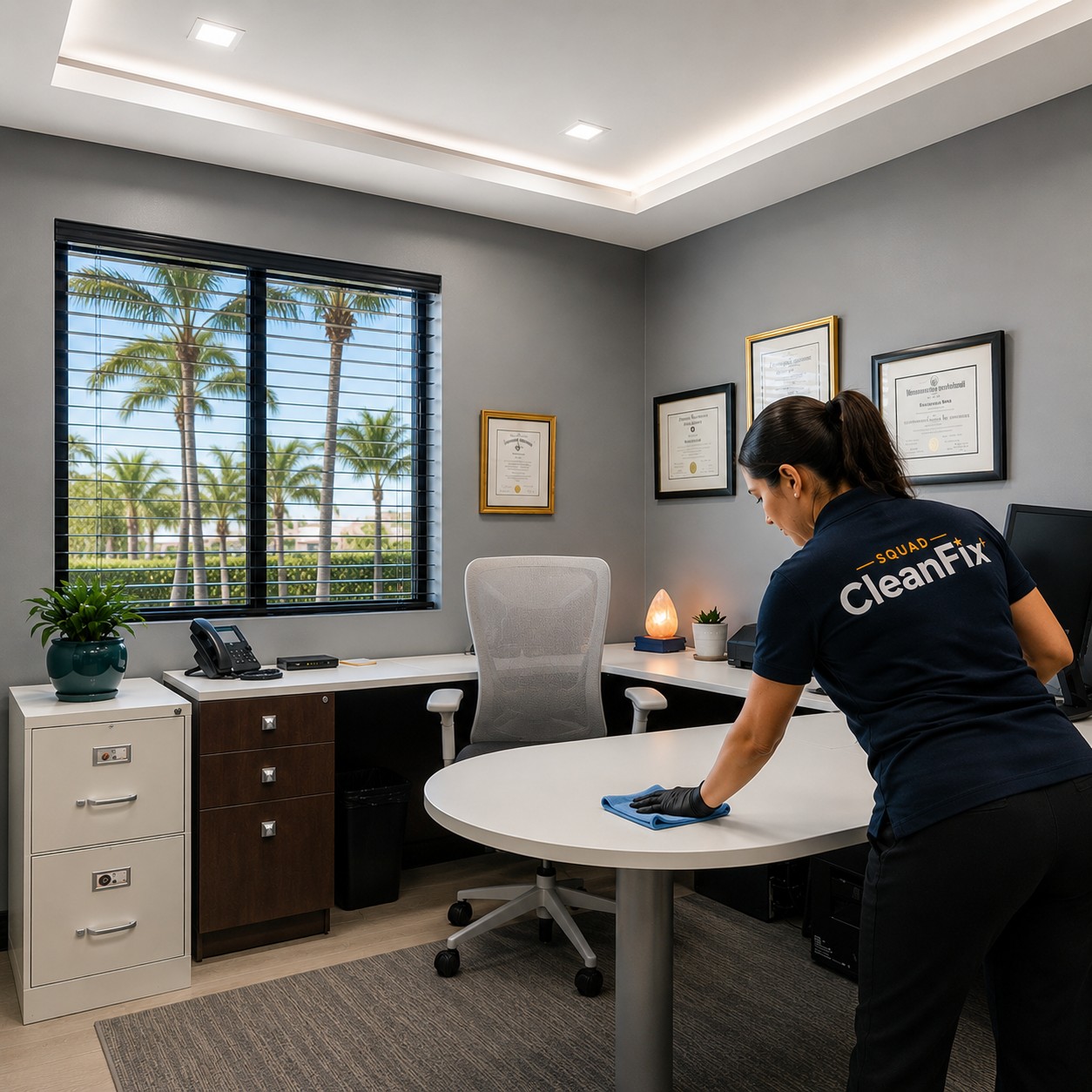
From June through October, South Florida offices, medical suites, and retail spaces face a set of cleaning challenges that don't exist anywhere else in the country. Afternoon thunderstorms drop an inch of rain in twenty minutes, tenants track water and sand across polished floors, humidity pushes HVAC condensation to the edge, and slip-and-fall liability spikes. A commercial cleaning Boca Raton or Fort Lauderdale property manager runs in July is not the same program they run in February.
This guide covers what changes during rainy season, where liability exposure hides in your existing scope, and how a professional janitorial services provider should adapt entry mats, floor protocols, restroom disinfecting, and HVAC-adjacent cleaning to protect your business through the wet months.
Table of contents
- Why rainy-season cleaning is a liability issue, not just an aesthetic one
- Entry-mat programs that actually work
- Wet-floor protocols and slip-risk mitigation
- Restroom and touchpoint disinfecting
- Mildew, condensation, and HVAC-adjacent surfaces
- Scope adjustments to negotiate with your vendor
- FAQ
Why rainy-season cleaning is a liability issue, not just an aesthetic one
The average South Florida commercial slip-and-fall claim settles for $20,000–$75,000 before litigation. Every one of those claims hinges on the same question in discovery: what was the property's documented cleaning and inspection protocol at the time of the incident? A rainy-season program that upgrades entry mats, wet-floor signage cadence, and floor-inspection logging is not overhead — it's insurance. Your commercial disinfecting and floor-care documentation is the paper trail that defends the claim.
Entry-mat programs that actually work
The single highest-ROI upgrade you can make between June and October is a real entry-mat system. Two 3x5 mats at a lobby door do nothing when a thunderstorm just dumped water across the parking lot.
- Outdoor scraper mat: aggressive rubber texture at every entrance to remove bulk water and grit before tenants step inside
- Transition mat: absorbent mat immediately inside the entry to catch remaining moisture
- Interior walk-off runner: 12–15 feet of absorbent runner extending into the lobby to finish the job
- Rotation schedule: mats swapped for dry replacements mid-day during heavy-rain periods, not just at night
Wet-floor protocols and slip-risk mitigation
During rainy season your commercial cleaning vendor should run a documented wet-floor protocol whenever precipitation is active. That means:
- Wet-floor caution signs deployed at every lobby entry, elevator lobby, and stairwell landing during and immediately after rainfall
- Hourly floor sweeps during business hours in high-traffic zones — not just nightly
- A logged inspection sheet showing timestamps, initials, and observed conditions
- Prompt mop-and-dry response to any visible standing water, followed by re-signage until fully dry
If your current janitorial services vendor doesn't produce inspection logs during rainy season, ask them to add it. If they refuse, that answers the question about who's carrying your liability exposure.
Restroom and touchpoint disinfecting
Rainy-season foot traffic pushes restroom usage up 20–30% in most office buildings — guests, delivery drivers, and tenants who came in soaked and need to freshen up all cycle through the same fixtures. Commercial disinfecting frequency should scale with that.
- Restroom checks every 2 hours during business hours in higher-traffic properties
- Touchpoint disinfect (door handles, elevator buttons, common-area countertops) added mid-day during rainy stretches
- Restock pars increased for paper products through the summer
- Hand-sanitizer stations refilled and inspected weekly, not monthly
Mildew, condensation, and HVAC-adjacent surfaces
The invisible half of rainy-season cleaning is the humidity war. Dew points above 75°F push HVAC condensation to the limit, and any surface where cold air meets warm air becomes a mildew candidate within days.
- Vent grille dusting and disinfecting monthly instead of quarterly during summer
- Window sill and interior door-frame inspection for early mildew spotting
- Ceiling tile inspection near HVAC diffusers — a discolored tile is usually a condensation leak, not a roof leak
- Restroom exhaust vent cleaning to prevent moisture accumulation
Scope adjustments to negotiate with your vendor
Most commercial cleaning contracts are written once and then coasted on for years. Before rainy season, ask your janitorial services provider to add a written summer addendum covering:
- Three-stage entry-mat program at every public door
- Documented wet-floor inspection log during precipitation events
- Increased restroom check frequency (every 2 hours in tenant-heavy properties)
- Mid-day touchpoint disinfecting added between May and October
- Monthly vent-grille and HVAC-adjacent cleaning through summer
None of these should trigger a large cost adjustment — they're the difference between a real commercial cleaning Boca Raton program and one written for a market that never rains.
Talk to a commercial cleaning company built for Florida summers
CleanFix Squad services offices, medical suites, retail, and multi-tenant buildings across Boca Raton, Delray Beach, Boynton Beach, Fort Lauderdale, and Broward County with documented rainy-season protocols. See our commercial cleaning service or request a quote and we'll walk your property first, quote second.
FAQ
How often should commercial floors be checked during Florida's rainy season?
Every hour in high-traffic lobbies during business hours, and immediately after any rain event. Any professional janitorial services provider should be logging those checks with timestamps.
Does commercial disinfecting need to increase during summer in South Florida?
Yes. Restroom traffic and touchpoint transfer both rise 20–30% in rainy season, so mid-day touchpoint disinfecting and 2-hour restroom checks should be added between June and October.
Are entry mats really that important?
A three-stage mat program (scraper + transition + walk-off runner) removes roughly 85% of tracked water and grit before it reaches finished flooring. Two 3x5 mats catch maybe 25%. The difference shows up in slip claims.
What's the biggest rainy-season cleaning mistake South Florida property managers make?
Running the same winter scope through July. Rainy season needs a written summer addendum with entry-mat, floor-inspection, and touchpoint-disinfecting adjustments — not a promise to 'keep an eye on it.'